Monday, October 29, 2007

Fixing annoying "delete to go back" in Firefox

One of the most popular posts here on my blog was where I explained how to get click -hold contextual menus back in Firefox 2.0 Why on earth they thought Mac users would enjoy having to hold the control key whenever they want to see a contextual menu is beyond me.

I love firefox but another hugely annoying feature is that hitting the delete key jumps you backwards though the browser history. Who thought that was a good idea? If you think your cursor is in a text field and it isn't then you're in for a nasty surprise when you hit the delete key to edit your text and you navigate away from your current page. What kind of power user is in such a hurry they can't take the two seconds to hit the back button? Who needs to rapidly speed backwards though their history like that. Even if such users do exist, why the delete key? (that's the Backspace key for you PC users)

There are lots of instructions online about how to disable this feature using the config menu. It is easy and anyone can do it if you can follow directions.

  1. Open a new Firefox tab (apple+T) so you can work in one window and read these direction in the original.
  2. Type "about:config" into the address field of the new window. Hit return and the config page appears.
  3. Enter "browser.b" into the "filter" field at the top.
  4. Click-hold the "Browser.backspace_action" Value column, and choose Modify from the pop-up menu. Type 2 for the new value.
  5. Click OK.
You're done! Annoying problem solved.

~kirk

Tuesday, October 23, 2007

135 Birds and Counting!

While on a visit to the St. Croix Watershed Research Station on Sunday, September 23rd I spied three broad winged hawks in the sky circling in a mini kettle. Someone suggested that with only 3 birds it should be called a pot or perhaps a cup instead of a kettle. har har har. Bird humor.

October 4th we had a naturalists' staff meeting at the nature center and while meeting in the lounge, Paul pointed out a blue headed vireo hopping up and down the bark of a large oak out the window. It must have been feasting on insects hiding in the bark. I had no idea they could hold onto the side of a tree like a nuthatch. Very cool to see.

The morning of October 18th I headed out to the George W. Mead Wildlife Area in Wisconsin as part of a conference we were attending. We expected lots of migrating waterfowl but were disappointed. We did find a pond with lots of American Coots (hundreds?) but the only other birds in the pond were five lesser scaups and a couple of pied billed grebes. We kept searching and found some red winged blackbirds, swamp sparrows, field sparrows and juncos. Just outside the wildlife area we stopped at a small pond and spotted a lonely redhead swimming. Hmm, if you don't know that a redhead is a kind of duck is sounds kind of bad that we watched a redhead swim in a pond though our binoculars! Just after we left the wildlife area I spotted a half dozen or so sandhill cranes in a farm field.

October 19th Paul and I woke up extra early to go on an early morning bird hike with other naturalists. I can't believe I got up that early to look at essentially the same birds I see at work everyday.

We left the conference October 20th and we spotted a ruby crowned kinglet though due to a momentary lapse of reason we could not figure out what kind of warbler it was. Duh, it wasn't a warbler. We kept on hearing kinglets so we should have put two and two together sooner than we did. I did spot a brown creeper as well which is always fun.

On the way home to Minnesota, co-worker Bekah spotted a white bird sitting up in a tree on the side of the road. I pulled over turned around ( something that NEVER happens unless I'm driving with other naturalists) and we were super excited to see that the bird was a Krider's Red-tailed hawk. It looks like an albino but it has the red tail. I'd never seen one so that was very cool. It is still a red-tailed hawk so I'm not counting it on my list.

131 Broad-winged hawk
132 Blue headed vireo
133 Swamp Sparrow
134 Redhead
135 Ruby Crowned Kinglet

Tuesday, October 16, 2007

Cool Dog Window


I think our dog Odin would love one of these. This is a great idea I stumbled upon out there on ye old internete. Now, how to make one? Or, just buy one from pet peek.

~Kirk

Sunday, October 14, 2007

Cephelopod Fossil

I joked a few posts ago about bringing home a 10 foot long cephelopod fossil. Well, that has yet to happen. I did find a cephalopod fossil though. About a month ago I took some Girl Scouts to Lilydale Regional Park in St. Paul to look for Ordovician aged fossils. We found the usual suspects in the usual spots and after the group left I ate a quick lunch and headed back into the park to scope out some other sites. I've never had time to fully explore the site so I was looking forward to seeing if there were some other spots I could take groups. I also did a little more exploring in the stream bed and that's where I found this gem.


The kicker is that this is from a much much larger animal and the rest of it was nowhere to be found. It is either still in a hillside or more likely, broken into dozens of pieces and every piece has been found by a different person. Oh well, such is fossil hunting at this site. It is about as picked over as they come. It is still a really cool piece and I'm excited to have it in my collection.

~Kirk

Wednesday, October 10, 2007

Teach both sides!

Consider this an addendum to my last post.

~Kirk

Sunday, September 30, 2007

Where's the Beef?

With all the posts about dinosaurs lately I thought this would be timely.

I recently happened upon one of the major creationist websites and read some of their mind-boggling "science." Creationists rail against evolution and complain that the fossil record is incomplete. They claim there are no transitional forms. They don't claim the transitional forms were not fossilized mind you, they claim they did not exist. The reason they claim they did not exist is that they do not appear in the fossil record and if they had existed they would have appeared.

Real scientists point out that the fossil record is incomplete because the creation of fossils is a sporadic event occurring over a long time period that requires specific conditions. Even given that, there are very few paleontologists and a LOT of ground to cover. Only a tiny fraction of the dinosaurs that are fossilized have been dug up and identified.

Creationists ignore this fact and prefer to believe that the fossil record was created by the great flood. Only animals that existed at the time of the flood could have been killed and buried and fossilized. Since we don't find transitional forms, they didn't exist.

Ahem, herein lies the rub for creationists. There are two huge logical problems with their argument.

First off, if the flood was the singular event that formed fossils and the flood only lasted one year then DUH there aren't any transitional forms because evolution doesn't happen in one year. You can't simultaneously say all the fossils were formed in one year and then claim evolution is false because the "snapshot" of animal life the flood fossilized in one year doesn't' show transitional forms. You can either have fossils being formed over millions of years and then you get to complain about missing transitional forms or you get fossils formed in one year by the great flood but then you can't complain about missing transitional forms. You can't logically have it both ways.

Choose one.

Secondly, Noah took two of each animal onto the ark right? Let's look at a fairly common animal. Deer. If he took two deer onto the ark that leaves, oh, let's say a few billion deer that didn't make it onto the ship. They died in the flood. So did all of the bears, goats, horses, chickens, wolves, kangaroos, squirrels, moose, cows, pigs, etc. that were not the lucky two chosen. The idea creationists but forward is that there are no dinosaurs now because they died in the flood. That is why we find them fossilized.

Hold on here a second.

Dear creationists, if Noah only took two of each animal onto the ark then there were millions of individuals from each species that DID NOT make it onto the ark and would have died in the flood. There are lots of dinosaurs that creationists and young earth believers think died in the flood. Please show me a fossil of a deer, a bear, a goat, a horse, a chicken, a wolf, a kangaroo, a moose, a cow or a pig.

Better yet show me hundreds of millions of them because hundreds of millions would not have made it onto the ark and they would have died right alongside the dinosaurs. They don't show up in the fossil record and you claim that animals that don't show up in the fossil record don't exist. That's weird because I could swear I've seen cows, bears, goats, horses, etc. yet they aren't in the fossil record with the dinosaurs.

You can't have it both ways.

Come to think of it where are the fossils of the millions of people who died in the flood? Why don't we find axes and houses and ox-carts and humans and dogs and sandals and cooking utensils mixed in with dinosaur fossils?

Bah! It isn't worth wasting more time on it. We don't find these things because the world wasn't formed the way some guys with no scientific understanding sitting in a tent thousands of years ago dreamed it was created. If you are a creationist and you read this please explain why when a transitional form can't be found it means the scientists are wrong but it is all hunky dory when creationists can't find a single fossil cow, pig, etc. when there should be millions.

~Kirk

Wednesday, September 26, 2007

Saprophyte No More . . .


My knowledge is obsolete

The last week of summer camp I discovered some unusual plants in the forest with my campers. I immediately recognized them as saprophites.

Sapro: meaning obtaining nutrients from non-living matter and phyte: meaning plant.

Here's the problem. My knowledge is obsolete. I wanted to identify the exact species and apparently saprophyte is a term no longer used. It was explained to me years ago that a saprophyte is a plant that lacks chlorophyll and thus obtains nutrients from decomposing organic matter. The problem is that now scientists say no plant can do that. What is actually happening is that the plant is engaging in parasitic behavior. It parasitizes a fungi to steal nutrients and it is the fungi that are taking the nutrients from the decaying matter. You may think it is a technicality, the plant is stealing nutrients from fungi rather than taking them from decaying matter, however now scientists say the term saprophyte is technically incorrect and misleading.

They now refer to a plant such as this as a Myco-heterotroph. Great, the kids will really remember that. It isn't a saprophyte kids, it is a myco-heterotroph. I had a hard enough time teaching the word saprophyte to third graders. In reality, they will probably remember the name Ghost Plant, Corpse Plant or Indian Pipe better. I think that's what this is. I've seen it here before but this clump looks different. I think what you see in the photo is an already pollinated flower. The petals have fallen off and it is now standing up straight as opposed to nodding.

Either way, fairly elusive and very cool.

~Kirk

Monday, September 24, 2007

Dinosaur Dig (part 4)

Ah, Thursday and Friday. We're almost at the end of our journey. I'm not posting anything about Friday as it was just our drive home.

After our rain day Wednesday we were itching to get back out in the field on Thursday.

We had a fantastic day. I drank over four liters of water in the field and I was still thirsty. I can see how if you were to run out of water out there it could be bad very quickly. It wasn't even that hot. The week before we arrived they were having temperatures in the 100s.

The arrow on the left shows the view of our van from where we ate lunch Thursday. That white splotch is an 18 foot long 15 passenger van.

Here's the same photo uncropped for comparison. We hiked though this basin and stopped atop this butte for lunch. The spot we're sitting in is relatively flat as they removed a triceratops from this site a few years ago. There were some bone scraps left behind and little pieces of plaster from making a field jacket for the beast. Can you imagine carrying the dinosaur back to where the van is in this photo?

I sometimes read complaints that the fossil record in incomplete. This sometimes comes from those who oppose the theory of evolution. They argue that there has been plenty of time for scientists to find all the fossils they need and transitional forms have not been found.

Have these people ever gone on a dig? The dinosaurs are embedded in hard rock. First you have to find one, then you have to have the time and resources to spend a year or more getting it out of the ground. This often involves taking off layers of stone many feet thick, one exacto blade scrape at a time. Imagine scraping away a whole hillside of hard rock with a dull exacto blade in blazing heat and humidity. Once you finally uncover the dinosaur you have to make a plaster field jacket and then transport it back to a lab (which in some cases means building new roads just to reach the site) It doesn't end there, you have to spend possibly years cleaning and assembling it. Once you see the vastness on an area like this and then realize there are essentially two or three people with a shoestring budget trying to find the treasures that have been battered by erosion and covered over for 65 million years and you begin to see how it may take some time to fill in our gaps in understanding. This is still a very young science and there are many millions of critters still waiting to be dug up.

Thursday was all about microsites. That means we spent a good part of the day sitting on the ground moving painstakingly forward looking for teeth and small limb bones. At the third site of the day I found two dromeosaur teeth but stupidly didn't take a picture. This particular site was still of scientific interest so we couldn't keep anything. It was similar to the teeth pictured here.

In the photo to the left we're heading home for dinner on Thursday. You can click on it (or any photo on the blog) to view a bigger image. The barbed wire fence on the left hand side of the picture marks the border with Montana. I could have spent many more hours in the field I was having so much fun. I inhaled a huge dinner of nachos and encheladas after the hour and thirty minute van trip back to Marmarth. I was very excited to not have hot dish.

I had a great time on the trip and I can't wait to return. I'll have to though. With a baby due soon I won't be able to sneak away for a week to look for dinosaurs next summer. We need to line up some funding as well. In the mean time I'll have to content myself hunting down an relatively complete ordavercian period cephalopod along the banks of the Mississippi or perhaps a complete crinoid. That should keep me busy. Chelsey will be less than thrilled if I do manage to find and bring home a six foot long cephalopod fossil. "Where do you intend to keep that?!"

Well, that's all for now. I'm sure the trip will generate a few more posts.

~Kirk

Friday, September 21, 2007

130 Birdies!

I finally made it to 130 birds. What a milestone. While visiting Chelsey's parents in La Crosse I spotted several tufted titmice (bird 128) in the trees by their home. I figured I would see some there at some point. Every time she calls them in the summer I can hear PETER! PETER! in the background. It was inevitable I would spot one there. There were also female ruby throated hummingbirds kicking through.

On September 10th I attended the Metro Naturalist Training at the Coon Rapids Dam. There were lots of great blue herons and a couple of great egrets. For the record, there were also Canada geese, mallards and a cardinal. The new bird for the list there was a ring billed gull (bird 129). This is sort of a gimme I save for this time of year when the pickins are lean. I probably saw one earlier but I purposefully willed myself not to id birds in the cub foods parking lot.

At Warner Nature Center, where I work, we have weekly trail assignments to force us naturalists to get outside. It seems silly to have to force naturalists outside but you get busy and then feel guilty about going on a hike (which is just as important to our training as anything else.) We need to know what goes on out there if we're going to teach about it.

On my hike today I hiked the new Esker Trail. I spotted bluebirds and goldfinches in the prairie. Once I veered into the woods and hiked along the lake I spotted wood ducks and a flock of white throated sparrows. All in all by the end of my hike I counted over 50 wood ducks. I also saw a green heron and a small group of Myrtle (yellow rumped) warblers. Bird 130 came as a real surprise. A bird landed on a branch right in front of me and I peered through my binoculars. I instantly recognized it. It was an ovenbird. That's bird species 130 for the year. I heard overbirds all summer but was never able to see one. Now that they have stopped calling here one plops down in front of me. Figures. What will be next? I see shorebirds and water fowl in my future as I head to a conference in Wisconsin next month.

128 Tufted Titmouse in La Crosse (Holmen)
129 Ring-billed gull-at metro training
130 Ovenbird

Monday, September 17, 2007

Flying Sharks and Ray Surfing


So my friend Andrea just got back from Japan and while she was there she took a photo of a completely bizarre sign. I cleaned up the image a bit to what you see above. Whatever it means it would make a great T-Shirt. Can anyone read Japanese?

~Kirk

Sunday, September 16, 2007

DInosaur Dig (part 3)

Tuesday night we heard a rumble in the air. No, it wasn't one of the two nightly coal trains that sped through town about 50 feet from my window, it was a storm. This is perhaps a good point to put in a picture of the "roads" we traveled on to get to the sites. These are not roads, they are two-track ranch trails through the Little Missouri National Grasslands. Rain is not a good thing for two tracks as it makes them impassable mud pits.

Even at their best, these two tracks are a crazy ride. The kids said it was more fun than Valleyfair. It was a lot of fun to drive and it felt a lot wilder than it really was. We paused to take this photo on what was a pretty typical slope. From inside the van it felt like this was an extreme 45 degree angle when in reality it was only about 18 degrees. Still, that's not normal.

It doesn't look that bad you say? Okay, okay, you'll have to check out the video. The first rule of two tracks is that each track does not need to be at the same height. This was not for people who get carsick!


Wednesday morning we headed into Montana to the little town of Ekalaka where locals drove by again and again to look at the strangers. I'm glad we could entertain them. Ekalaka is home to the Carter County Museum which has a nice small fossil collection including a large hadrosaur, a copy of the skull of Peck's Rex, and a triceratops skull. There were other nice small paleo items as well.

Being the county museum it also featured historical items. My brother would have appreciated the two headed calf. Now that's history we can all ogle at and appreciate. Here's a picture for you Erik.


We ate lunch at the historic and sacred native site the Medicine Rocks which locals have taken care of for the tribes by carving their names, two feet high, into the soft sacred stone. Way to go Montana. It was pretty disgusting not to mention horribly insulting. It would be a little like carving "Class of 95 RULZ!!!" into the crucified Jesus's chest over the altar in a catholic church. God bless America!

We finished up Wednesday by making some plastic replicas of dinosaur teeth and claws. We were supposed to get in some time in the lab but someone (who will remain nameless) decided even though we paid for the experience they should close up the lab early for the season. In the photo, I am showing kids how to add a little natural grit to their replica t-rex tooth to give it that fresh-out-of-the-ground look. Hopefully they aren't selling theirs on ebay as the real deal. Thanks to Doug for letting us work out of his garage as a temporary lab!


That's all for Wednesday!

~Kirk

Thursday, September 13, 2007

What's Erik Mona doin?

Friends sometimes ask, "What's your brother up to?"

Wonder no more
.

~Kirk

Wednesday, September 12, 2007

Woodchuck


Ah the woodchuck. (also known as the groundhog, whistle pig and woodland marmot)

I did this drawing a while back. It is just a little sketch and the photo of it isn't the best. I thought I would share it anyhow. Enjoy.

~Kirk

Tuesday, September 11, 2007

Dinosaur Dig (part 2)

Here's post number 2 about my dinosaur hunting trip. I present, Tuesday.

Tuesday we headed out to the Triceratops site. This was very neat to see, though a bit confusing as the skeleton was not complete. I know what a sacrum and ilium are but I'm guessing the kids didn't. I would include a photo but unless you know what you are looking at it just looks like a shot of the ground.

The previous day, a group had made a plaster field jacket for the triceratops femur so we helped haul that out. It was very heavy. That's me on the back right getting ready to lower it down a small hill. I think the dark blotch on the horizon might be the truck we're carrying it to. The field jacket consists of a 2x4 for support, some foil and a lot of plaster strips.


While waiting to carry out the femur I did a little prospecting and located a rich trail of bone fragments coming down the hillside maybe 100 feet from the triceratops. I called the rest of the group over and we followed the pieces up to the top of the hill where they stopped. We dug a little but didn't find anything. The two experts with us looked at some of the pieces we found and could tell that they were triceratops frill. It was really cool to follow the trail and start looking for more even though we didn't turn up anything. They hadn't found the head of the triceratops they were excavating 100 feet away so perhaps it disassociated when it died and we were finding pieces of the head of the one they were digging up. Who knows.

Here I am doing a little cleaning up on a different piece of frill. You can see the lines from where the blood vessels were. If you think that triceratops were cold blooded then you think the blood vessels were there to help heat up the dinosaurs via passive solar collection. If you think they were warm blooded then the blood vessels may have helped it cool down. I'll leave that debate to the experts.

FYI: The stylish latex gloves are actually to keep paint and chemicals off my hands as we were making plastic casts of dinosaur pieces on the table in the background.


Later that day we climbed to the top of a butte and felt one of the strongest winds I've ever felt in my life. I took this clip of video but it doesn't do the force of the wind justice. You can get a good view of the basin we are about to descend into as I pan across the landscape. This is my first ever video in a blog post. I'll have better ones in the future!


Atop this bluff we collected some of the K-T boundary. This is the geologic boundary between the Cretaceous and Tertiary periods. This layer of ash comes from the meteorite impact that slammed into the Yucatan peninsula 65 million years ago and almost ended all life on earth. The actual K-T boundary here is very visible, one of the best spots on earth to see it. You can even see yellow ribbons of iridium in the black. Iridium in this concentration generally only comes from meteors.

For reference, check out this satellite photo.


View Larger Map
The marker marks the exact spot we collected the KT boundary. Can you see why they call this the Hell Creek formation? It isn't a real hospitable location. The basin to the south of the butte is where we spent the day hiking and looking for fossils.

We headed down into the basin and scouted out several cool sites. We found many pieces of turtle shell. Most pieces were about the size of a quarter.
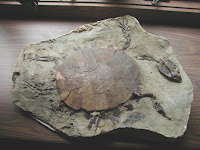
The pieces I found are from trionychid turtles such as this one. The complete one in the photo is a replica in the Warner Nature Center collection. For size reference, that is a standard countertop it is sitting on and the fossil takes up the entire depth of the counter. These large turtles are related to the soft shelled turtles that inhabit rivers today. The basic turtle design is evolutionarily very robust and has changed little over time.

At one particularly interesting site after lunch I picked up some broken pieces of fossil that had washed into a small wash coming off a hillside. Since the pieces were found close together (within a five foot stretch) and all appeared similar I put them into their own bag and asked our leader about them. He said they were from a turtle and that I could keep them as they were just broken scrap type pieces. I took them home and to my delight two of the pieces fit together. As I played with them a second piece fell into place and then a third, then a fourth. All in all there were 18 pieces and 9 of them fit together. That's pretty impressive.

What I can tell is that it is a portion of the anterior right plastron of a turtle. I have one piece of carapace as well. You can see the curved up portion where the plastron would have connected to the carapace of the turtle. It seems about twice as thick as the trionychid shell pieces we found so I need to do some digging to get and idea of what species I'm dealing with. My impression is that trionychid turtles did not have such solid plastrons. I'll post pictures at some point.

I had a great time putting all the pieces together. I just wish I had a whole turtle to work with! It was a like a fantastic challenging jigsaw puzzle but in the end, instead of a photo of a basket full of puppies or kittens, you end up with a fossil of an animal that lived 65 million years ago. Pretty damn cool.

We continued on our hike through the basin learning about geology and fossils until our water ran out and we needed to head back. We spotted a badly crumbled hadrosaur femur on the ground and noted it with GPS before turning for home. Maybe another group can look longer at this area next season.

That's all for Tuesday. More to come later!

~Kirk

Tuesday, September 04, 2007

Laser Magician

I used to be a magician so I enjoy seeing how the art progresses. This one was new to me. I like lasers too so what's not to like. I get how he does this, it isn't anything too overly complex as but he does it so well! Enjoy the video.


~Kirk

Wednesday, August 29, 2007

Dinosaur Dig (Part 1)

Last summer I taught my regular Fossils to Feathers summer camp and fellow Warner naturalist Bekah Dalen brought in some fossils to show me. She said she got them on a dinosaur dig while working at the Children's Museum. Hmm, we thought, why don't we lead a dinosaur dig though Warner?

Here were the two selling points.

1. Digging up dinosaurs
and
2. Getting paid to do it

Need I say more?

We offered the summer camp this summer and a little over a week ago we took seven kids on a 10 hour van ride to the far nether regions of North Dakota to root around in the famous Hell Creek Formation. (Okay, famous to other geeks, geologists and paleo-types.)

We worked with Marmarth Research Foundation and the week was tons of fun. Fossil wise we found many pieces of trionychid turtles and parts of another species of turtle I need to identify. We found champsosaur bones, a hadrosaur femur, a triceratops femur, a triceratops tooth, a dromeosaur tooth, fossil trees, crocodile teeth, freshwater ray teeth, triceratops frill and more. The pictures tell a good story so let's start there.

We set out on Sunday for the 10 hour ride to Marmarth, ND. The highlight of the trip was of course stopping at the Middle Spunk rest stop in Minnesota (purely because of the name) and stopping to gawk at Salem Sue the world's largest holstein cow statue in New Salem, ND. That's six tons of reinforced fiberglass in the shape of a cow up there on that butte. She's actually the world's largest fiberglass animal. Okay so the picture is awful. Follow the link for up close giant cow bliss.

We arrived in Marmarth just in time for some Tater Tot hotdish. We found this quite hilarious as we were joking with the kids that dinner would be tater tot hotdish and there it was like culinary destiny. Little did we suspect at the time (how foolish) that hotdish would grace our lips at several dinners. The only one that was vile was the chow mein hotdish, the rest were edible. Oh I now wish I had a photo of the tater tot hotdish! There were some folks there from the east coast who were completely perplexed by the hotdish phenomenon. The term casserole was only slightly less alien.

That night we got our room assignments in the Marmarth Bunkhouse. The bunkhouse was built for railway workers back in the old days. As far accommodations for a dinosaur dig this was posh. Most digs involve sleeping in tents so this was nice. There was a phone, showers, private rooms and satellite TV. Weirdly, the kids all wanted to watch shows about serial killers while I preferred spongebob. Go figure.

Monday morning we headed out to a site where kids a few years ago uncovered a hadrosaur femur. There is still probably more of the dino inside the hillside but a LOT of rock would have to be removed to get at it. Maybe someday, but for now there are easier quarry. I found one of my first cool things here. It was a little piece of a trionychid turtle. It was thrilling but little did I know I would be seeing thousands of such parts in the next few days. This site was also home to many many modern rodent bones as a large owl roosted in the area and the ground was littered with bones and owl pellets. Our leader, Doug Hanks, showed us a profile of the rock in the area and taught us how to read the record of what had happened there.

Monday afternoon we headed out to another area to work on a site rich in turtles. It is apparently one of the richest turtle sites in the world. We didn't see any. I used an exacto knife to slowly carve out a one foot square area. In an hour our so I went down about four inches. This is the very unglamourous part of field work. Carefully looking for nothing. The area I worked in was where they had just removed six complete turtles so it was important to keep searching. It was too bad we didn't uncover anything but that's part of the job too.

Dinner Monday was meatloaf hotdish. When I say meatloaf I mean many many pounds of ground beef tossed into a pan, covered in ketchup and baked. I think there may have been a can of "cream of something" soup mixed in. Welcome to flavor country. Why didn't I take any pictures of the food?

That's it for the first installment. I'll post up the rest of the week soon.

~Kirk

Wednesday, August 22, 2007

Improve Blogger

Here's an excellent script that makes your blogger edit box much bigger. The box used to edit posts in Blogger is way too small but this Greasemonkey script fixes that.

Get Firefox, Install Greasemonkey, Install this script, be happy.

Rinse lather, repeat.

~Kirk

Birds while I Blog

I've got some cool blog posts I am working on but they will take a while to finish up. The big post is about the dinosaur dig I was on two weeks ago. I promise to post something soon. It will have video and clickable satellite photos and be worth the wait.

In the mean time it is time for a simple bird count update. I saw five new species in North Dakota and two new species since I returned home. That means I have broken my personal best record for number of birds spotted in one year. Of course, this is my second year so one would expect that.

I wasn't in North Dakota to bird so all sightings were almost accidental. For example, two of the birds I spotted and identified for sure only when the van we were in stopped to open a cattle gate as we crossed through the Little Missouri National Grasslands. Here's the North Dakota list.

121 Western Meadowlark
122 Lark Bunting
123 Lazuli Bunting
124 Red Breasted Nuthatch
125 Swainson's Hawk

Yesterday while I was locking up the building at work I head a barred owl in the distance. I called to it only to be surprised when an owl answered from les then 100 feet away. These two birds called back and forth until the jays came and chased to owl away. I was surprised how rapid a call the owl in the distance used. I've never head the "who cooks for you, who cooks for you-all" spit out in three seconds like that.

Today I arrived at work and Paul told me there were Tennessee Warblers in the bog. I grabbed my binoculars and headed down. Sure enough they were dripping off the trees. The warbler migration has begun. I also spotted a beautiful great crested flycatcher and a catbird. The flycatcher was hunting close to the ground as the entire bog was etheiral nad filled with fog this morning.

So, for the numbers game that's:

126 Barred Owl
127 Tennessee Warbler

Monday, August 20, 2007

The Baby Blog

So I can't believe I haven't posted this yet.

If you want to follow my adventures into fatherhood you can read up on my other blog, Adventures in DNA Mixing.

~Kirk

Tuesday, July 17, 2007

Would you believe birds?

It seems like it has been a long time since I posted about birds. Such is the middle of summer. It gets hard to find new birds for my list. I did finally manage to creep up to 120 birds this week.

On June 20th I added two birds. I added the clay-colored sparrow and a blue-winged warbler. I was one of the few people at work that day and no one had gotten the mail yet so I hiked out to the mailbox. I spotted a blue-winged warbler along the driveway on the way to the mailbox. Rule number one. Always bring binoculars, everywhere.

On the way back I cut through the prairie/savanna restoration and could hear the distinctive call of the clay colored sparrow. Paul had taught it to me earlier in the month and while I had heard it everywhere the actual birds had eluded me. Sitting on top of a big slash pile was a little brown bird. With my binoculars I thought I could tell it was the one singing. I crept closer and sure enough it was the clay-colored sparrow.

The nest week was the first week of summer camp and I lead a trip of kids down the St. Croix river. The first night we heard but didn't see a whip-poor-will. The second night we camped out at Goose Creek and a pair of sandhill cranes flew right over our heads. They landed on the opposite shore to eat. We got a great view. As I remembered, the goose creek campsite is thick with American redstarts and the wood thrushes were singing beautifully from the woods. The second morning (June 29th) I arose early and birded along the quiet shore as mist lifted off the water. I saw another blue-winged warbler but there was another bird hanging out with it. I finally got a good luck and to my delight it was a golden-winged warbler. There was another misc. vireo about that morning. It looked like it was probably a red-eyed vireo but I'm going to hold off on counting it since I didn't get a great look.

Bird 120 was a pleasant surprise. I don't get to add many birds to my list from my treeless suburban back yard. I've done a lot to encourage birds including feeders and a new pond. The improvements have brought in cardinals, robins, house sparrows, chickadees, goldfinches, and chipping sparrows but I kept on saying where the hell are the house wrens! I have two next boxes up that would be suitable but I don't so much as see a single sign of the wrens. Then, just the other day (July 15th)there were two of them hanging out on my back porch and playing around in the mulberry bush. Believe it or not they were the first ones I had seen all year. I really hope they see what a nice place my yard is and decide to stick around.

Woo hoo, 120 birds. I'm going to beat last year.

117 Clay-colored sparrow,
118 Blue winged warbler
119 Golden-winged warbler
120 House Wren

~Kirk